Case studies
Accelerating Daikin Europe’s sales operations through document intelligence
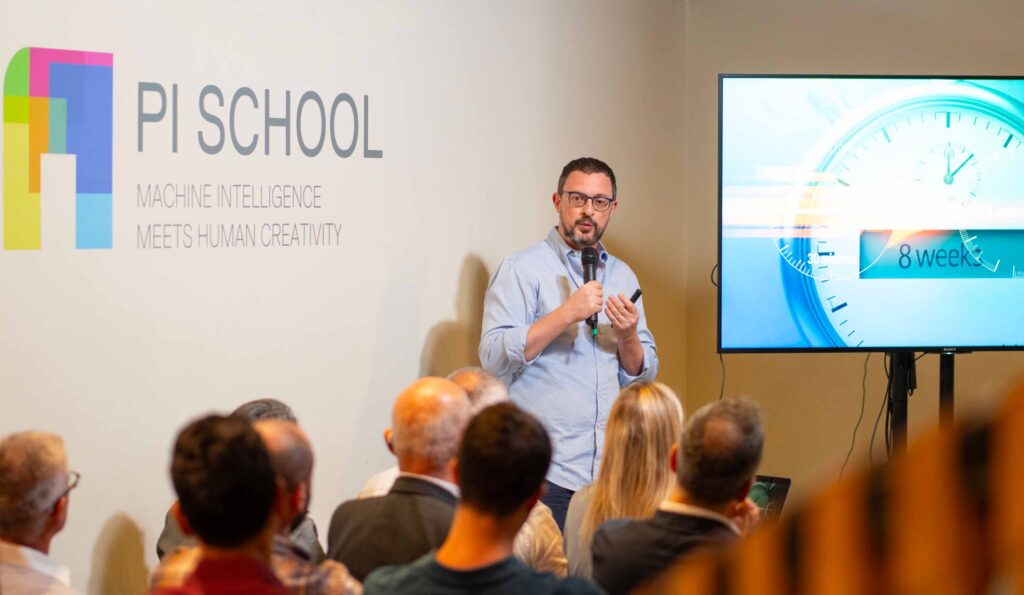
How Pi School assisted Daikin Europe in transforming a time-consuming sales process
For Daikin Europe, preparing an offer for a potential customer requires analysing project files of around 50 pages each. These documents contain essential technical specifications, including cooling capacity, electrical supply, motor details, environmental conditions, and more. For the sales team, this step traditionally meant 30 minutes to 1 hour of technical reading per lead, before even starting the quoting and machine-selection process. This workload scaled quickly as the number of incoming leads increased.
The challenge
Daikin’s sales engineers faced a bottleneck:
- Hundreds of documents in inconsistent formats (PDFs, images, scanned text).
- Time-consuming manual extraction of technical data.
- Risk of human error during the reading and transcription phase.
- Delays in preparing accurate quotes, especially when inquiries were urgent.
The process flow shown in the slides makes the pain point clear:
Project File → Technical Reading → Data Extraction → Quote & Sale → Machine Selection
Project File → Technical Reading → Data Extraction → Quote & Sale → Machine Selection
The solution: introducing Trallie
Trallie is an open-source LLM-based framework developed by Pi School for NGI Search, which automatically converts unstructured documents into searchable, structured data. The tool analyses PDFs or collections of documents and outputs clean JSON files containing only the technical attributes needed for decision-making.
Its pipeline combines:
- Schema Generation – automatically identifying the relevant fields in a dataset.
- Data Extraction – pulling out exact values for each attribute from each document.
- Support for multiple file types, including PDF, TXT, HTML, and raw text.
- Validation and multilingual support for 5 EU languages.
The Impact: From One Hour to 13 Seconds
The slides visualise a dramatic result:
Trallie reduces document-reading time from ~30 minutes to just 13 seconds
Trallie reduces document-reading time from ~30 minutes to just 13 seconds
This acceleration allows Daikin’s sales team to:
- Process more incoming requests without increasing staff workload.
- Reduce human error in retrieving critical technical values.
- Standardise extraction results across teams and markets.
- Free engineers to focus on analysis, design choices, and customer interactions, not document decoding.
A Real Example
Trallie extracts key attributes such as:
- type_of_chiller: “water”
- required_peak_cooling_capacity_total_kw: “15600”
- electrical_supply_v: “6600”
- electrical_supply_ph: “3”
- electrical_supply_hz: “60”
These details are derived from textual and tabular sections scattered throughout the document, including sections that describe free cooling systems and electric motor data.
Why this matters
By automating the extraction of technical specifications across long and complex files:
- Offers can be prepared more quickly and accurately.
- Teams can respond rapidly to more leads, increasing sales opportunities.
- Essential technical insights become instantly searchable, improving internal knowledge flow.
- The time saved translates into measurable business impact.
Thanks to Trallie, Pi School was able to transform Daikin Europe’s manual, error-prone document reading process into an automated, scalable one. What once required hours of human effort across a team now takes seconds, enabling Daikin to handle more leads, build faster offers, and maintain a competitive edge in a demanding market.
Interested in applying this approach to your workflow?
Book a call with us