Press release
Pi School and ESA release EVE, the AI expert making Earth science accessible to all
FOR IMMEDIATE RELEASE
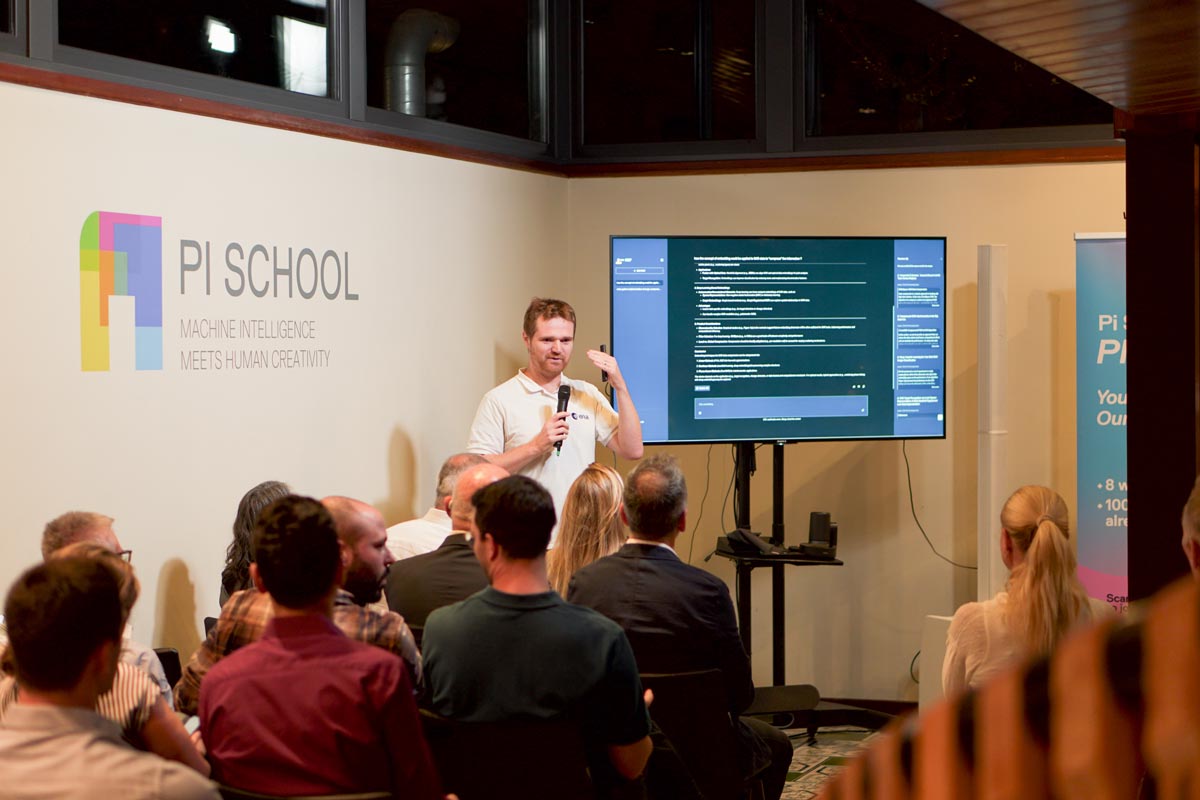
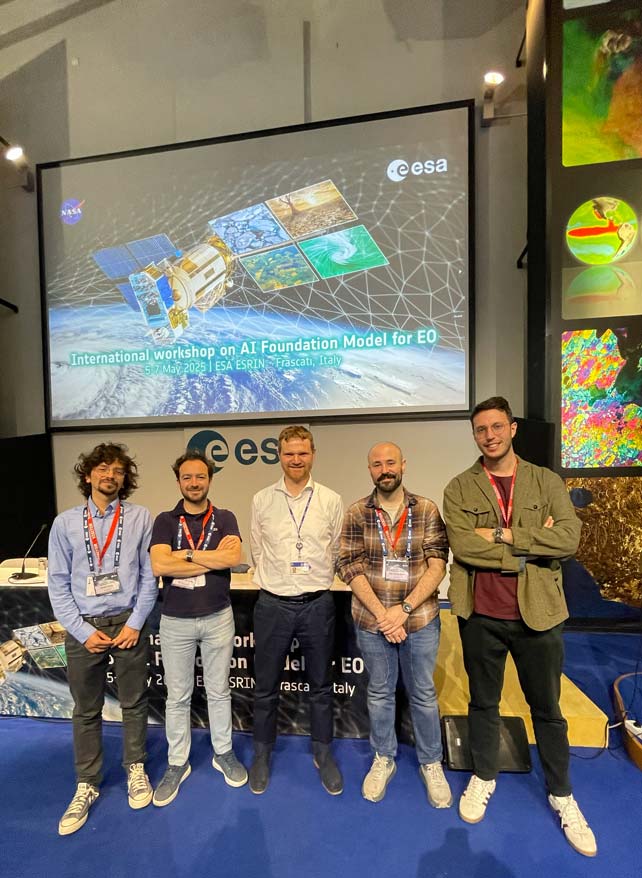
Rome, 08/10/2026 – EVE, the Earth Virtual Expert, is now publicly available. Anyone can create a free account at https://eve.philab.esa.int and start using it today. EVE has been developed under the Foresight element of ESA’s FutureEO programme, with a €2 million investment from ESA. Pi School led the design, development and integration.
The system answers complex Earth-related questions in plain language, drawing on real Earth observation data, peer-reviewed science, and validated content from Wiley, a global leader in authoritative content and research intelligence for the advancement of scientific discovery, innovation, and learning.
At the core of EVE technology is Mistral Small 3.2’s open-source Large Language Model, a leading European alternative to closed AI systems that demonstrate high performance, transparency and responsible artificial intelligence. The synergy among the European Space Agency, Pi School, Mistral and Wiley allows EVE to combine the power of open-source innovation with scientific integrity, resulting in responses that are not only accessible but also trustworthy and grounded in academic rigour.
This release marks a significant milestone for Europe’s AI and EO ecosystems, showing how collaborative innovation across space, science, and AI can yield tools that serve both society and the environment.
Europe’s Copernicus Sentinel satellites alone produce more than 20 terabytes of data every day. Turning that data into knowledge that researchers, students, teachers, and policymakers can actually use has long required specialist expertise that most people don’t have. Turning that data into knowledge that researchers, students, teachers, and policy-makers can actually use has long required specialist expertise that most people don’t have access to. EVE is set out to close that gap.
“I have always believed that the most meaningful AI is the kind that serves society. Seeing Pi School collaborate with ESA Φ-lab on EVE is a reminder that, when science, openness, and AI come together, we can make some of the world’s most complex knowledge accessible to all.”
Isabelle Andrieu, CEO of Pi School and serial entrepreneur.
From data to understanding
Earth observation produces an overwhelming volume of technical data, from satellite imagery to climate models, that rarely reaches the public in usable form. EVE closes that gap by letting anyone ask a direct question and receive an answer grounded in verified EO data and peer-reviewed science. Specifically, EVE is directly connected to about 300k open-access articles and more than a million closed-access articles from the Wiley Gateway [1].
A journalist reporting on wildfire risk in southern Europe can ask EVE to explain the environmental conditions behind a fire outbreak, drawing on scientific literature rather than piecing together technical papers. A policymaker assessing drought impacts can obtain a clear, well-sourced summary of the underlying EO indicators. An educator preparing a lesson on deforestation can retrieve accurate, referenced explanations in minutes rather than hours.
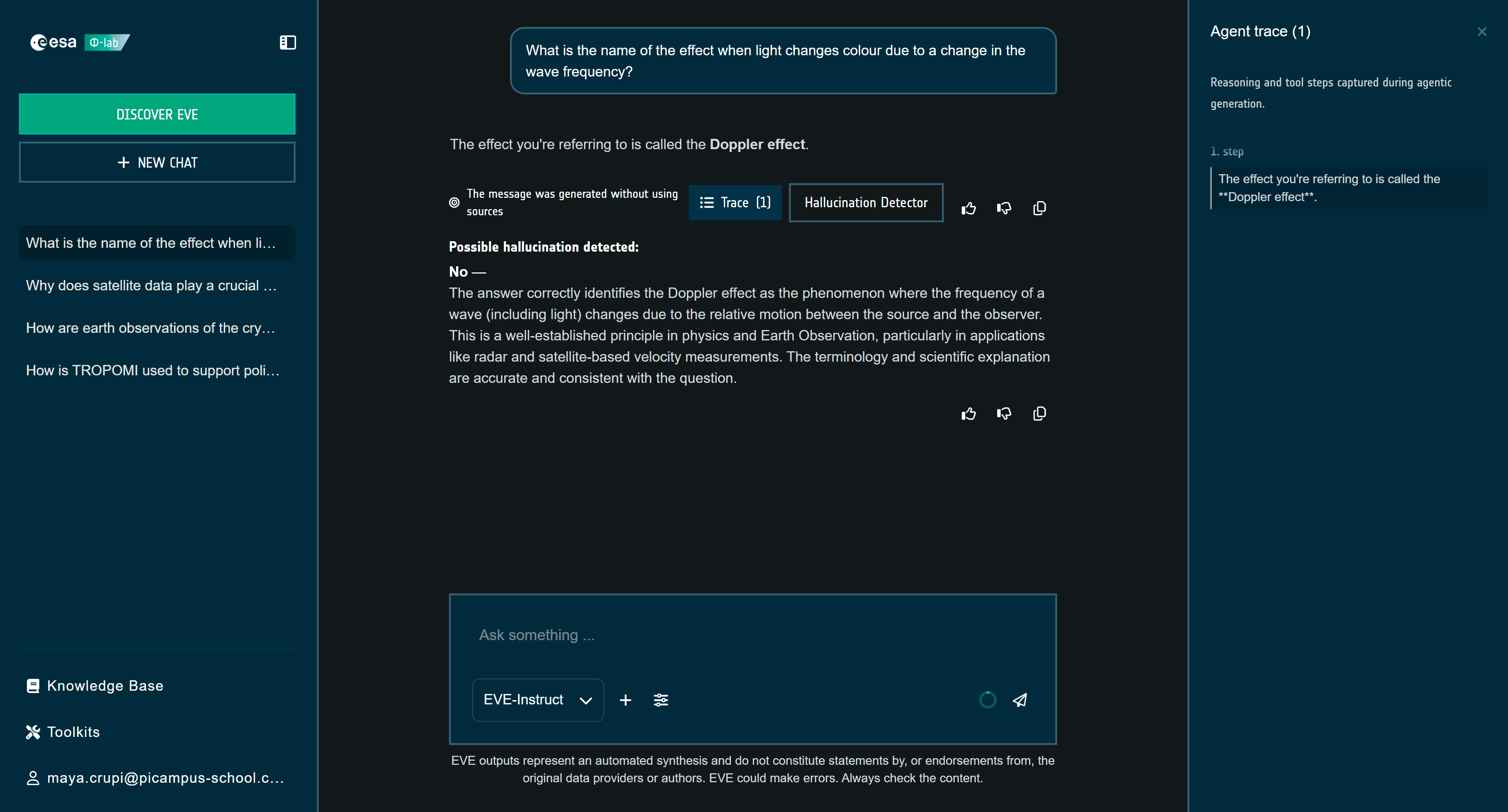
This is what distinguishes EVE from a general-purpose chatbot. Every answer is traceable to EO data and validated scientific sources, making it a reliable starting point for reporting, teaching and policy work on climate and environmental change. Beyond the web interface, EVE is also accessible through a public API, allowing developers, researchers and organisations to integrate its capabilities directly into their own applications and workflows.
This launch is a beginning
EVE will be actively maintained and regularly updated by Pi School and Imperative Space under ESA Φ-lab guidance, with new releases planned over the coming weeks and months. The next phase will add agentic capabilities: EVE will be able to plan multi-step analyses, retrieve and process Earth observation data, and run tools on the user’s behalf, rather than only answering questions. Model weights, code and data will remain fully open, with every update published on the project’s public repositories.
—Giuseppe Borghi, Head of the ESA Φ-lab Division.“One of the goals with EVE is to open up the world of Earth observation to a much wider audience. EVE makes it possible for anyone to discover, understand and use trusted Earth observation information. Every aspect of its development has been guided by scientific rigour, transparency and traceability, so that users can explore complex topics with confidence.”
—Apoorva Shah, VP, Wiley Applied Research Intelligence“EVE demonstrates how AI can help address global challenges when it is built on trusted knowledge and clear provenance. By combining Wiley's Earth science research with AI, the project makes scientific and satellite intelligence more accessible to policymakers, researchers, and innovators, while maintaining transparency around the sources behind every insight. We're proud to have partnered with ESA Φ-lab and Pi School on a project that helps bring authoritative scientific knowledge to the people making decisions about our planet's future."
—Ravi Kapur, Managing Director, Imperative Space"We are pleased to be continuing this work with ESA Φ-lab and Pi School as EVE enters its next phase. Giving EVE access to important EO tools and up-to-date information will empower people from a wide array of disciplines to learn, access and analyse EO data. We'll keep engagement and accessibility at the heart of that, because a tool of this kind only earns its value when the widest possible range of people can use it with confidence."
In line with the project’s open-science mandate, model weights, datasets, source code, a technical report, and a compliance whitepaper are all released openly and available through the links at the end of this release.
Try EVE now: https://eve.philab.esa.int
Read the announcement from ESA.
Resources:
Model and data (https://huggingface.co/eve-esa)
Code (https://github.com/eve-esa)
Scientific article (https://aclanthology.org/2026.acl-industry.72/)
Compliance whitepaper (https://zenodo.org/records/18415713)
[1] Copernicus Observer: Cool facts for your next Copernicus small talk
ESA: Care (2025)
Requests for interviews and media contact
Lucia Bracci, Communication Manager at Pi School / email: lucia.bracci@picampus-school.com
About Pi School
Pi School is a research and innovation company born from two decades of building AI for real-world impact.
Founded in 2017 by Marco Trombetti and Isabelle Andrieu, it is backed by 27 years of AI heritage through Translated, the founders’ company and a leader in the language industry worldwide.
Pi School embeds AI research expertise within organizations tackling complex challenges, contributing to open science along the way and bridging the gap between academia and institutions.
To date, Pi School has delivered more than 100 AI solutions, trained over 250 engineers through the Pi School of AI programme, and secured more than €7M in EU grants.
It leads and contributes to research initiatives funded by the European Commission and the European Space Agency. These include:
DVPS, which is building multimodal foundation models spanning language, environment, and medicine with €29M in EU funding.
Meetween, developing speech technology and AI agents for video conferencing with Translated (€7M):
EVE, a 24-billion-parameter LLM for Earth Observation developed with ESA Φ-lab (€2M);
SatcomLLM, a domain-specific LLM for satellite communications under ESA’s ARTES programme with RINA (€400K);
Edith, an AI-powered Virtual Human Twin for clinical decision support (€5M).
Media Kit
To download an image, right-click on it and select “Save image as”. On mobile, press and hold the image.
These assets may be used in editorial coverage of Pi School and EVE. Please do not alter, recolour or crop the logos.
Logo



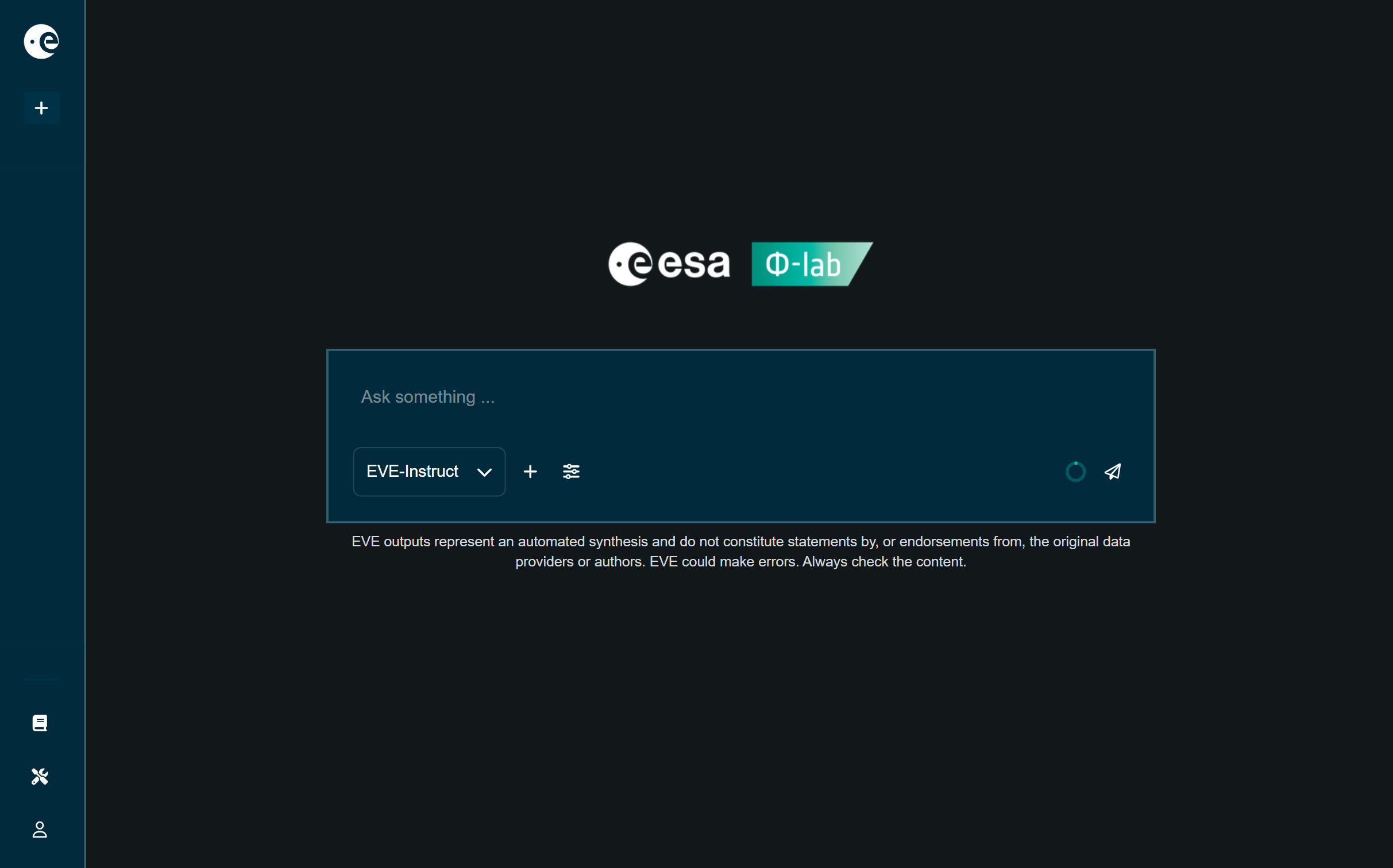
Interface
Pictures